

Sales executives know the frustration: account research consuming over 3 hours per deal, forecasts missing targets, and teams stretched thin. AI-powered sales analytics is rewriting this narrative in 2026, delivering 35% better forecasting accuracy while slashing research time by 40%. This shift isn't just about automation, it's about empowering your team to close more deals with precision and speed.
Table of Contents
- The Challenge: Lengthy And Inefficient Sales Analytics Processes
- How AI Revolutionizes Sales Analytics In 2026
- Key Considerations And Best Practices For Implementing AI In Sales Analytics
- Real-World Impact: Measurable Benefits From AI Adoption In Sales Analytics
- Explore AI-Powered Sales Solutions With Sales Company
- Frequently Asked Questions
Key takeaways
| Point | Details |
|---|---|
| Research efficiency | AI cuts account research time by up to 40%, freeing sales teams for high-value activities. |
| Forecasting precision | Predictive analytics deliver 35% better accuracy compared to traditional forecasting methods. |
| Deal closure impact | Teams using AI analytics close 20% more deals through data-driven insights. |
| Implementation essentials | Privacy safeguards, bias audits, and human-AI collaboration ensure ethical, effective adoption. |
The challenge: lengthy and inefficient sales analytics processes
Your sales team spends precious hours manually researching accounts, compiling data from scattered sources, and building forecasts on gut feelings rather than predictive intelligence. The numbers tell a harsh story: 71% of enterprise sales teams report account research exceeding 3 hours per deal. That's time stolen from relationship building, strategic planning, and actually closing deals.
Traditional forecasting compounds these inefficiencies. Spreadsheet-based models rely on historical data without accounting for market shifts, buyer behavior changes, or emerging opportunities. Sales leaders make critical resource allocation decisions based on incomplete information, leading to missed quotas and unpredictable revenue.
The productivity drain extends beyond individual tasks:
- Manual data entry errors corrupt pipeline visibility
- Inconsistent research quality across team members creates uneven performance
- Reactive rather than proactive strategy limits competitive positioning
- Time spent on administrative tasks reduces actual selling hours
This traditional approach leaves B2B sales teams perpetually behind, struggling to keep pace with buyers who expect personalized, timely engagement. The gap between research effort and deal conversion widens as competitors adopt smarter tools. Solutions that shorten account research time are no longer optional for teams serious about hitting aggressive growth targets in 2026.
How AI revolutionizes sales analytics in 2026
AI transforms sales analytics from a backward-looking reporting exercise into a forward-thinking strategic asset. Machine learning algorithms continuously analyze thousands of data points across your CRM, communication platforms, and external sources, surfacing patterns invisible to manual analysis.

Account intelligence platforms aggregate buyer signals in real time. Instead of spending hours researching company financials, org charts, and recent news, AI presents a unified view within seconds. It identifies decision makers, tracks engagement patterns, and flags buying signals like budget approvals or personnel changes that indicate readiness to purchase.
Predictive forecasting reaches new accuracy levels. AI sales analytics deliver up to 35% better accuracy than traditional methods by analyzing deal velocity, stakeholder engagement, competitive positioning, and seasonal trends simultaneously. Your forecast becomes a strategic planning tool rather than a best guess exercise.
Automation extends beyond research:
- Call analysis transcribes and scores conversations for coaching opportunities
- Lead scoring updates dynamically based on behavior and firmographic changes
- Pipeline health alerts notify reps when deals show risk signals
- Next-best-action recommendations guide daily priorities
Pro Tip: Start with one high-impact use case like call analysis or lead scoring rather than attempting full-scale transformation. Prove ROI in a contained area, then expand based on demonstrated results and team adoption feedback.
The productivity gains compound quickly. AI adoption in revenue operations boosts productivity by up to 15%, freeing experienced reps to focus on complex negotiations and relationship deepening. Junior team members accelerate their learning curve by accessing AI-generated insights that previously required years of experience to develop.
Consider this comparison of traditional versus AI-enhanced workflows:
| Task | Traditional Time | AI-Enhanced Time | Time Saved |
|---|---|---|---|
| Account research | 3+ hours | 45 minutes | 70%+ |
| Weekly forecast prep | 4 hours | 1 hour | 75% |
| Call review and coaching | 2 hours per rep | 30 minutes | 75% |
| Lead prioritization | 1 hour daily | 10 minutes | 83% |
Predictable client acquisition systems integrate these AI capabilities into unified workflows, eliminating the friction of switching between tools. Your team operates from a single source of truth, with AI augmenting every decision point from prospecting through close.
Key considerations and best practices for implementing AI in sales analytics
Successful AI adoption requires more than purchasing software. Ethical considerations and implementation strategy determine whether AI becomes a competitive advantage or an expensive distraction.
Data privacy forms the foundation. B2B buyers trust you with sensitive business information, competitive strategies, and personal contact details. Anonymize data and audit for bias before feeding information into AI systems. Establish clear policies about what data gets analyzed, how long it's retained, and who can access AI-generated insights.
Transparency builds stakeholder confidence:
- Explain to clients how AI enhances their experience without compromising confidentiality
- Document AI decision logic so sales leaders understand recommendation rationale
- Create override processes when human judgment contradicts AI suggestions
- Regular bias audits ensure models don't discriminate based on company size, industry, or geography
Human-AI collaboration outperforms either approach alone. Combine human intuition with AI pattern recognition by using AI for initial triage and prioritization, then applying human judgment to nuanced relationship dynamics. Your top performers shouldn't feel threatened by AI, they should view it as amplifying their expertise.
Pro Tip: Involve your best reps in AI implementation from day one. They'll identify edge cases the algorithms miss and build buy-in across the team. Their domain expertise improves model training while their advocacy accelerates adoption.
Avoid over-reliance on unverified models. New AI tools flood the market daily, each promising revolutionary results. Validate claims with pilot programs before committing enterprise-wide. Start with established platforms that offer transparent methodologies and provide case studies from similar B2B contexts.
AI-human collaboration in sales works best when you establish clear roles: AI handles data aggregation, pattern identification, and routine task automation, while humans own relationship strategy, complex negotiation, and ethical judgment calls. This division lets each party operate in their strength zone.
Real-world impact: measurable benefits from AI adoption in sales analytics
The theoretical benefits of AI translate into concrete business results across industries. Teams using AI analytics close 20% more deals by identifying high-probability opportunities earlier and allocating resources more effectively.
A mid-sized SaaS firm illustrates this impact. After implementing AI-driven call analysis and predictive scoring, they achieved a 22% close rate increase within six months. The AI identified specific conversation patterns that correlated with closed deals, allowing reps to adjust their approach in real time.
Time savings create capacity for revenue-generating activities:
- 40% reduction in research time per account
- 45% of sales tasks automated, including data entry and follow-up scheduling
- 3 additional prospect conversations per rep per day
- 25% faster ramp time for new hires accessing AI-generated insights
Enterprise adoption accelerates as ROI becomes undeniable. AI adoption is expected to reach 78% of enterprises in 2025, with productivity gains ranging from 26% to 55% depending on implementation scope. Early adopters establish competitive moats that become harder to breach as their AI models improve through accumulated data.
Compare the performance metrics:
| Metric | Pre-AI Baseline | Post-AI Implementation | Improvement |
|---|---|---|---|
| Average deal close rate | 18% | 22% | +22% |
| Forecast accuracy | 65% | 88% | +35% |
| Hours per closed deal | 47 | 28 | -40% |
| Pipeline value per rep | $840K | $1.1M | +31% |
The financial impact extends beyond top-line revenue. Reduced customer acquisition costs, improved resource allocation, and higher rep retention from reduced frustration all contribute to healthier unit economics. Sales leaders gain predictive visibility that enables confident investment in growth initiatives.
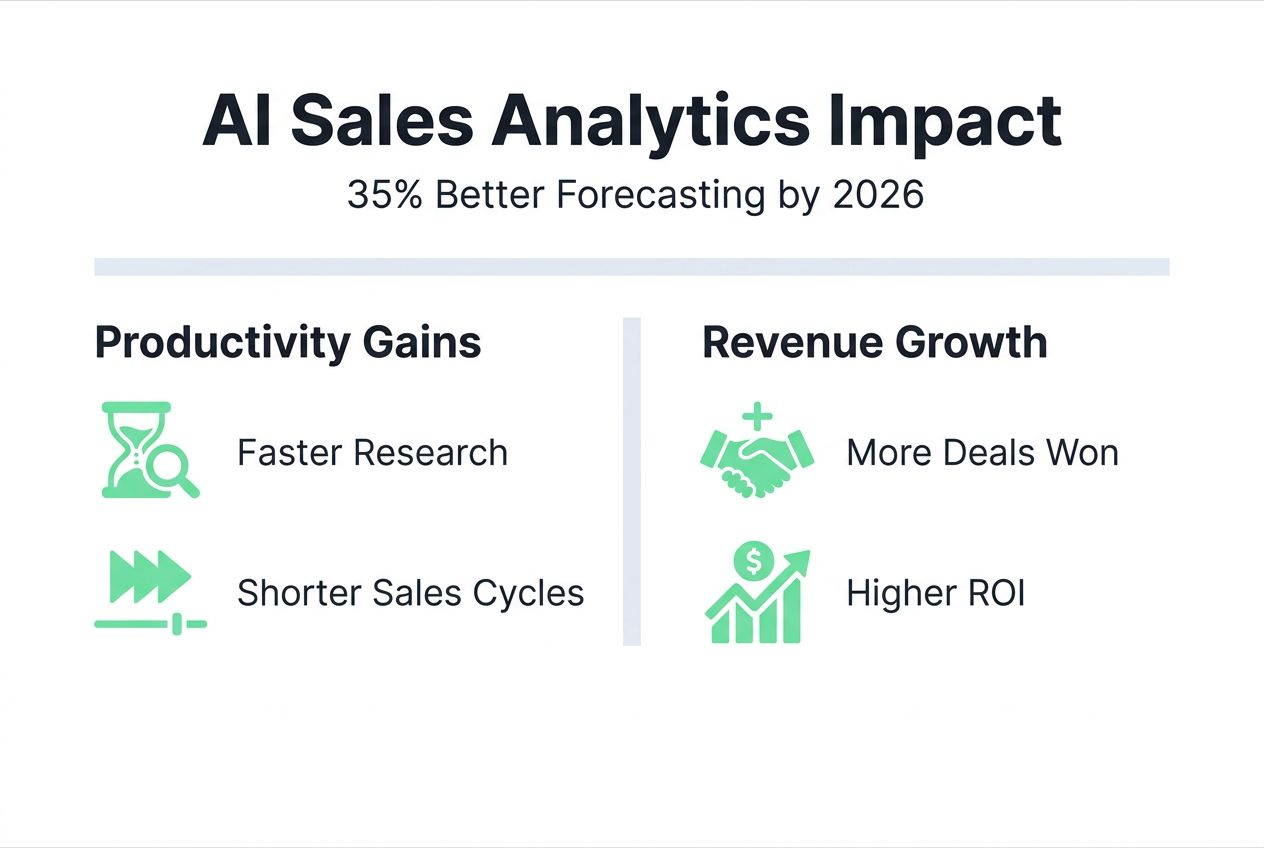
Lead data modules for sales provide the enriched information AI needs to generate accurate insights. Clean, comprehensive data forms the foundation for predictable sales outcomes that transform sales from an art into a science.
Explore AI-powered sales solutions with Sales Company
Ready to transform your sales analytics from a time drain into a strategic advantage? Sales Company delivers predictable B2B client acquisition systems that integrate AI-powered forecasting, automated account research, and intelligent pipeline management into a unified workspace.
Our platform combines CRM functionality with autonomous AI teams that handle outreach, lead qualification, and meeting scheduling across email, social, and messaging channels. You'll access the same AI-driven insights driving 20%+ deal closure improvements for growing B2B teams, without hiring additional personnel or mastering complex technical skills.
Explore proven outbound sales team strategies that leverage AI to compress sales cycles and scale pipeline generation. The Nexus CRM personal assistant acts as your always-on analyst, surfacing opportunities and risks before they impact quota attainment. See how AI can unlock your team's potential today.
Frequently asked questions
What is AI sales analytics and how does it improve forecasting?
AI sales analytics uses machine learning algorithms to analyze historical sales data, buyer behavior patterns, and market signals to predict future outcomes with greater precision. Unlike traditional methods that rely on linear projections, AI identifies complex patterns across thousands of variables simultaneously, delivering up to 35% better accuracy. This enables sales leaders to allocate resources proactively and set realistic quotas based on data rather than intuition.
How does AI reduce time spent on account research in sales?
AI tools continuously aggregate data from CRM systems, public databases, news sources, and social platforms to build comprehensive account profiles automatically. When a rep needs account intelligence, the AI presents synthesized insights within seconds rather than requiring hours of manual research. This reduces research time by up to 40%, allowing reps to focus on relationship building and strategic conversations that actually move deals forward.
What privacy and ethical concerns should sales teams consider with AI?
Data privacy stands as the primary concern, requiring teams to anonymize sensitive client information and establish clear policies about data retention and access. Bias auditing ensures AI models don't systematically disadvantage certain company types or industries based on training data limitations. Transparency with both clients and team members about how AI influences decisions builds trust, while human oversight prevents over-reliance on algorithmic recommendations that lack contextual understanding.
How quickly can B2B sales teams see ROI from AI analytics implementation?
Most teams observe measurable improvements within 90 to 180 days, starting with time savings from automated research and data entry. Deal closure rate improvements typically emerge by month six as AI models accumulate sufficient data to generate accurate predictions. The key is starting with focused use cases like call analysis or lead scoring rather than attempting comprehensive transformation immediately, allowing teams to build confidence and refine processes before expanding scope.
Do sales reps need technical skills to work with AI analytics platforms?
Modern AI sales platforms prioritize user experience, requiring no coding or data science expertise from end users. Reps interact with AI through conversational interfaces, dashboards, and automated alerts that present insights in plain language. The technical complexity happens behind the scenes, with AI handling data processing, model training, and pattern recognition automatically. Sales leaders should focus on change management and adoption rather than technical training when implementing AI tools.