

SDR productivity has collapsed by over 60% in the past decade, with appointment generation plummeting from 2.5 to 1 per day. This dramatic decline forces B2B sales teams and agency founders to rethink traditional outreach models. Autonomous sales workflows powered by AI agents now offer a proven solution to reverse this trend, delivering higher volumes of qualified conversations and appointments without expanding headcount. This article explores real-world examples, comparison frameworks, and practical implementation strategies to help you adopt these transformative workflows.
Table of Contents
- Criteria For Evaluating Autonomous Sales Workflows
- Example 1: AI-Driven SDR 'Jack' For High-Volume Conversations
- Example 2: Outreach's AI Prospecting Agent Transforming Revenue Workflows
- Comparison Of Top Autonomous Sales Workflows
- Choosing The Right Autonomous Sales Workflow For Your Business
- Discover How Sales Company Can Help You Implement Autonomous Sales Workflows
- Frequently Asked Questions
Key takeaways
| Point | Details |
|---|---|
| AI agents outperform traditional automation | Autonomous workflows handle lead qualification and personalized engagement dynamically, adapting to prospect responses in real time. |
| SDR productivity crisis demands new solutions | Declining human SDR efficiency has created urgent demand for AI-driven autonomous sales workflows that scale effortlessly. |
| Real examples demonstrate measurable impact | AI SDR 'Jack' generated 831 conversations in 30 days while Outreach's AI Prospecting Agent transformed enterprise revenue workflows. |
| Selection requires evaluating trade-offs | Top workflows vary in complexity, cost, integration ease, and training requirements, demanding careful vendor and feature comparison. |
| Phased adoption minimizes risk | Start with pilot programs, measure KPIs rigorously, and scale workflows aligned with business goals and resource capacity. |
Criteria for evaluating autonomous sales workflows
Choosing the right autonomous sales workflow requires a structured evaluation framework. You need to assess capabilities, flexibility, data control, and ROI potential before committing resources.
Start by examining each workflow's ability to autonomously qualify leads and personalize outreach. The most effective systems combine a Brain (GPT-4o), Nervous System (n8n.io), and Tools (APIs) to execute complex sales tasks without manual triggers. This architecture enables dynamic responses to prospect behavior rather than rigid automation sequences.
Flexibility and data ownership matter immensely for long-term success. Platforms like n8n.io are preferred for flexibility and self-hosting, giving you complete control over data and customization options. Vendor lock-in and proprietary systems can limit your ability to iterate workflows as your sales process evolves.
Key evaluation criteria include:
- Autonomous lead qualification accuracy and personalization depth
- Integration compatibility with existing CRM and sales tools
- Training time investment versus agent learning speed
- Measurable ROI through increased qualified conversations
- Scalability to handle growing prospect volumes
- Data ownership and security controls
Potential ROI should be measured by tangible outcomes like conversation volume, lead quality scores, and appointment booking rates. The best workflows demonstrate clear improvements within 30 to 60 days of deployment, providing early validation before full-scale rollout.
Pro Tip: Prioritize workflows offering self-hosted options or open APIs to maintain control over your sales data and avoid dependency on single vendors.
Exploring proven systems can accelerate your evaluation process. Consider frameworks designed for unlocking outbound sales that combine autonomous agents with established B2B acquisition strategies.
Example 1: AI-driven SDR 'Jack' for high-volume conversations
Jack represents a breakthrough in autonomous SDR performance. This AI agent was designed to initiate large volumes of prospect conversations while maintaining personalization quality that human reps struggle to achieve at scale.

In its first 30 days, Jack generated 831 conversations and surfaced 1,200+ prospect pain points, demonstrating unprecedented engagement efficiency. These pain points enabled sales teams to deliver highly targeted follow-up, dramatically improving conversion rates. The agent's ability to uncover multiple challenges per prospect created rich qualification data that traditional SDR outreach rarely captures.
Jack's operational workflow includes several key stages:
- Initial lead enrichment pulling firmographic and behavioral data
- Personalized outreach sequencing across email and social channels
- Dynamic conversation threading based on prospect responses
- Pain point extraction and CRM logging for follow-up prioritization
- Automated meeting scheduling with calendar integration
What sets Jack apart is the speed of content absorption versus creation. While training differs from ramping, with Jack absorbing material in an hour compared to weeks for human SDRs, creating high-quality training content still requires significant upfront investment. You need to develop comprehensive product knowledge bases, ideal customer profiles, objection handling scripts, and value proposition frameworks before deployment.
Pro Tip: Invest 3 to 4 weeks building robust training content libraries before launching your AI SDR to maximize agent effectiveness and minimize iteration cycles post-deployment.
This upfront content investment pays dividends through rapid deployment and consistent execution. Jack maintains message quality across thousands of interactions without fatigue or performance degradation, a critical advantage over human SDR teams facing burnout and turnover.
Businesses seeking to replicate this success should explore resources on AI-driven SDR training that outline content development frameworks and deployment best practices.
Example 2: Outreach's AI prospecting agent transforming revenue workflows
Outreach took autonomous sales workflows to enterprise scale with its AI Prospecting Agent. Launched in March 2025, this tool transitioned Outreach to an AI-first revenue workflow, fundamentally reshaping how the company approaches customer acquisition and retention.
The platform serves 6,000 customers including Cisco, Okta, SAP, and Verizon, validating its reliability and sophistication at scale. This customer base demonstrates enterprise readiness and the ability to integrate with complex sales ecosystems spanning multiple tools and stakeholders.
Outreach's autonomous workflow capabilities extend beyond basic prospecting:
- AI-powered lead qualification scoring based on engagement patterns
- Automated personalized email sequencing with dynamic content insertion
- Integration with AI-enhanced QA tools streamlining code review processes
- Commit forecasting aligning sales and finance teams for predictable revenue
- Real-time performance analytics identifying workflow optimization opportunities
| Feature | Outreach AI Agent | Simpler AI Agents |
|---|---|---|
| Enterprise integration | Native CRM, forecasting, QA tools | Limited API connections |
| Scale capacity | Thousands of prospects daily | Hundreds of prospects daily |
| Training complexity | Weeks of setup, ongoing tuning | Days to initial deployment |
| Customization depth | Deep workflow modification | Template-based configurations |
| Cost structure | Premium SaaS pricing | Lower entry costs |
The commit forecasting feature deserves special attention. By combining AI-driven pipeline analysis with historical conversion data, Outreach enables sales and finance teams to predict revenue with greater accuracy. This cross-functional alignment reduces planning friction and supports more confident resource allocation decisions.
Pro Tip: Leverage integrated forecasting tools within your autonomous workflow to build executive confidence and secure budget for scaling AI sales initiatives beyond pilot phases.
Outreach's success illustrates how enterprise-grade autonomous workflows can transform entire go-to-market strategies. Companies pursuing similar transformation should examine platforms offering predictable B2B client acquisition capabilities that combine AI agents with comprehensive sales infrastructure.
Comparison of top autonomous sales workflows
Understanding the trade-offs between leading autonomous sales workflows helps you make informed adoption decisions. Each platform offers distinct advantages and faces unique challenges.
Jack excels at high-volume prospect engagement with rapid content absorption, but success depends on substantial upfront training content investment. Your team needs weeks to develop comprehensive knowledge bases before deployment, though the agent learns this material in hours once created.
Outreach provides enterprise-grade integration and a full AI tool ecosystem spanning prospecting, QA, and forecasting. This breadth appeals to large organizations with complex sales processes, though premium pricing and longer setup timelines may challenge smaller agencies.
Salesforce Agentforce entered the market with significant hype but faced adoption and usage challenges, with less than 2% of customers using it extensively. User experience issues and integration complexity have limited its impact despite Salesforce's dominant CRM position.
Microsoft Copilot similarly struggles with market traction. Enterprises show reluctance to pay premium prices for AI agent tools, and brand preference challenges limit sales against competitors like ChatGPT. Integration advantages within Microsoft 365 haven't overcome these adoption barriers.
| Workflow | Key Strengths | Primary Limitations | Best For |
|---|---|---|---|
| AI SDR Jack | High conversation volume, rapid learning | Requires quality content creation | Agencies scaling outbound fast |
| Outreach AI Agent | Enterprise integration, full ecosystem | Premium pricing, complex setup | Large B2B sales organizations |
| Salesforce Agentforce | CRM integration, brand recognition | Low adoption rates, UX challenges | Existing Salesforce power users |
| Microsoft Copilot | Microsoft 365 integration | Brand preference issues, cost concerns | Microsoft-centric enterprises |
| DIY n8n Agents | Maximum customization, data control | Technical expertise required | Teams with developer resources |
This comparison reveals a critical insight: adoption success depends less on feature lists and more on alignment with your team's capabilities and workflows. The most sophisticated platform fails if your organization lacks the resources to implement and maintain it effectively.
Businesses evaluating these options should explore solutions for building lead packs that complement autonomous workflows with high-quality prospect data, maximizing agent effectiveness from day one.
Choosing the right autonomous sales workflow for your business
Selecting the optimal autonomous sales workflow requires honest assessment of your current capabilities and future goals. Generic recommendations fail because every business operates with unique constraints and opportunities.
Start by evaluating your specific business needs. Consider your monthly lead volume targets, existing technology stack compatibility, and available bandwidth for training content development. SDR productivity has collapsed over the past decade, making autonomous workflows essential, but implementation approaches vary widely based on organizational maturity.
Budget constraints and ROI timelines significantly influence workflow selection. Enterprise platforms like Outreach demand premium pricing but deliver faster time to value for large teams. DIY solutions using n8n cost less upfront but require developer resources and longer implementation cycles. Calculate your acceptable payback period before committing to any platform.
Follow this phased adoption framework:
- Define measurable success metrics including conversation volume, qualification accuracy, and appointment booking rates
- Select a pilot workflow segment representing 10 to 20% of your total outbound volume
- Deploy the autonomous workflow with comprehensive monitoring and weekly performance reviews
- Evaluate results after 30 to 60 days against baseline SDR performance and predefined KPIs
- Iterate workflow configuration based on learnings before scaling to full outbound operations
- Maintain ongoing optimization cycles as prospect behavior and market conditions evolve
Vendor support quality and workflow customization capabilities matter more than most buyers initially recognize. You need responsive technical support during implementation and the flexibility to adapt workflows as your sales process matures. Platforms with rigid templates or slow support cycles create bottlenecks that undermine autonomous workflow benefits.
Pro Tip: Begin with a focused pilot targeting your highest-value prospect segment rather than broad deployment to generate compelling ROI data that secures executive buy-in for scaling.
Businesses ready to implement autonomous workflows should explore platforms like the Nexus CRM personal assistant that combine AI agents with comprehensive sales infrastructure, reducing integration complexity and accelerating time to value.
Discover how Sales Company can help you implement autonomous sales workflows
Transforming your B2B sales process with autonomous workflows requires more than selecting the right technology. You need proven implementation frameworks, quality prospect data, and ongoing optimization support to achieve sustainable results.
Sales Company delivers predictable B2B client acquisition systems specifically designed for agencies and service providers seeking to scale outreach without expanding headcount. Our AI-enhanced workflows combine autonomous agents with comprehensive CRM infrastructure, eliminating the integration challenges that derail many implementations.
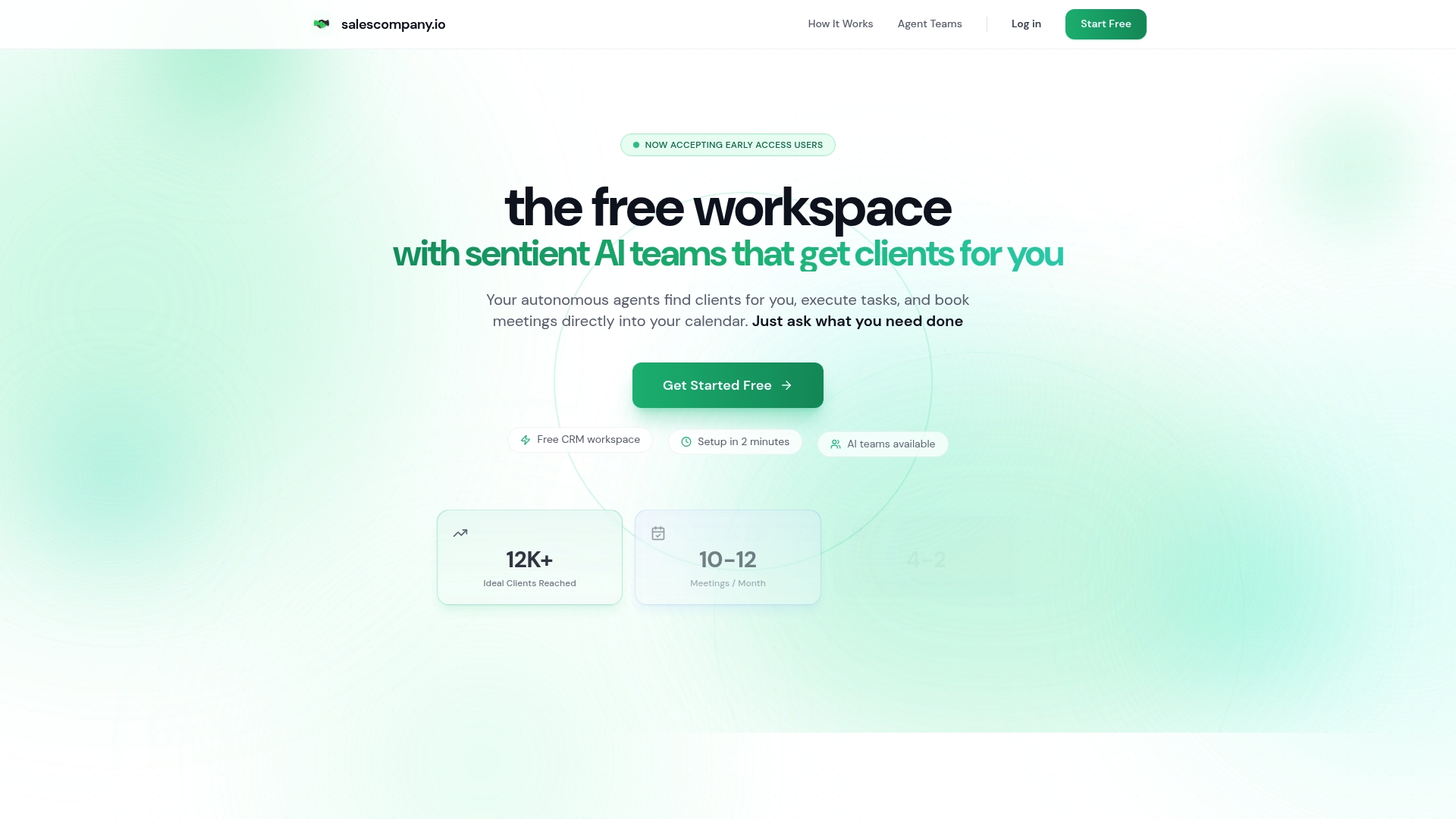
Whether you're struggling with declining SDR productivity or simply ready to scale beyond manual outreach limitations, our platform provides turnkey solutions tailored to your business model. Explore how to unlock the outbound sales team potential with AI-driven workflows that generate consistent qualified meetings.
Our Nexus CRM personal CRM assistant streamlines lead management while autonomous agents handle prospecting, qualification, and initial engagement. This combination frees your team to focus on high-value activities like closing deals and nurturing strategic relationships.
Contact Sales Company today to discover practical, scalable autonomous sales solutions aligned with your growth objectives.
Frequently asked questions
What are autonomous sales workflows?
Autonomous sales workflows are AI-driven processes that independently qualify leads, engage prospects, and schedule meetings without manual intervention. They combine AI agents with automation platforms to optimize sales funnel efficiency and scale outreach beyond human capacity limitations.
How can AI improve SDR productivity?
AI automates repetitive SDR tasks like lead research, initial outreach, and follow-up sequencing while improving engagement quality through personalization at scale. Autonomous agents like Jack demonstrate significantly higher conversation volumes, with SDR productivity having collapsed over the past decade making AI solutions essential for competitive outreach.
What challenges exist when adopting AI sales agents?
High-quality training content creation requires weeks despite AI's fast learning capabilities, creating upfront resource demands many teams underestimate. Enterprise adoption often lags due to user preference challenges and integration complexity, as seen with Salesforce Agentforce facing low adoption rates. Additionally, Microsoft Copilot encountered brand preference issues limiting sales despite Microsoft 365 integration advantages.
How do I choose the best autonomous sales workflow for my agency?
Match workflow complexity with your agency's capacity for training content development and technical integration, avoiding platforms that exceed your implementation resources. Pilot workflows with measurable KPIs like conversation volume and appointment booking rates before committing to full adoption. Consider vendor support responsiveness and compatibility with existing sales tools, exploring solutions like choosing Nexus CRM assistant that offer comprehensive implementation support and proven B2B acquisition frameworks.